Multimedia Challenge: Educational Comic Prototype
“My Brain Has Tabs Open”

Photo by Jesus Hilario H. on Unsplash
UNDERSTAND (Discover, Interpret, Specify)
What is the challenge?
This project explores how cognitive overload can affect learners when they interact with multimedia learning materials. Many students encounter slides, videos, or online modules that feel overwhelming, but they may assume that the difficulty is caused by their own ability rather than the design of the material.
The challenge for this comic is to explain cognitive overload in a simple and relatable way while also demonstrating how better multimedia design can reduce unnecessary mental load. The goal is to show that effective learning resources guide attention and organize information so learners can focus on the ideas that matter most.
Context and Audience
The intended audience for this comic is first-year university students or senior high school students who are frequently learning from digital materials such as lecture slides, online modules, and study resources.
Learners at this stage are often developing independent study strategies and may not yet recognize how design influences learning. When materials are cluttered or overly complex, students may interpret their confusion as a personal failure rather than a design issue.
Learners in this audience often benefit from:
• information broken into manageable pieces
• clear visual cues that highlight important ideas
• concise explanations that do not add unnecessary cognitive load
• reassurance that difficulty in learning does not always reflect ability
By presenting the concept through a comic narrative, the project aims to create a low-barrier explanation of cognitive load that is easy to understand and relatable for students.
POV Statement
A student who feels overwhelmed by cluttered learning materials needs a simple visual explanation of cognitive load so they can understand what is happening and learn strategies to engage with information more effectively.
Learning Outcomes
After reading the comic, learners should be able to:
• explain cognitive overload in plain language
• distinguish between intrinsic and extraneous cognitive load
• identify design features that increase cognitive overload (for example cluttered slides, excessive text, or unnecessary visuals)
• recognize strategies that reduce overload such as signaling, segmenting, and coherence
• apply at least one design strategy when creating or evaluating study materials
PLAN (Ideate, Sketch, Elaborate)
Big Idea
The comic follows a simple narrative where a student attempts to study but becomes overwhelmed by a cluttered slide. A guide character then introduces the concept of cognitive load and demonstrates how multimedia design principles can reduce unnecessary mental effort.
The story moves from confusion to explanation to redesign and finally to understanding. This progression helps learners see how thoughtful design can improve the learning experience.
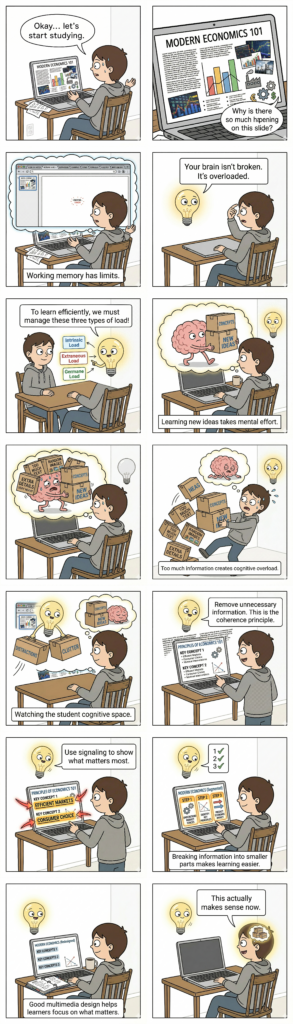
Storyboard / Script (14 Panels)
Panel 1
A student opens their laptop to start studying. The screen shows a chaotic slide filled with text, graphs, and images.
Panel 2
The student looks confused and overwhelmed by the amount of information on the slide.
Panel 3
The student’s brain is shown as a browser with many open tabs.
Caption: Working memory has limited capacity.
Panel 4
A friendly guide character appears and reassures the student that the issue is overload, not intelligence.
Panel 5
The guide introduces the idea that learning involves different types of cognitive load.
Panel 6
Intrinsic load is shown as blocks labeled “new ideas” and “concepts.”
Panel 7
Extraneous load appears as unnecessary blocks such as “extra text,” “decorations,” and “random images.”
Panel 8
The learner struggles to hold all of the information, showing how overload occurs.
Panel 9
The guide begins removing the unnecessary elements from the slide.
Panel 10
The slide becomes cleaner with fewer distractions, demonstrating the coherence principle.
Panel 11
Important information is highlighted, showing the signaling principle.
Panel 12
Information is organized into smaller steps labeled Step 1, Step 2, and Step 3, demonstrating the segmenting principle.
Panel 13
The student now understands the material and looks relieved.
Panel 14
Final message: When unnecessary cognitive load is reduced, learning becomes easier and more effective.
Design Choices and Theory Connections
This comic intentionally applies several multimedia learning principles.
Coherence Principle
Unnecessary elements are removed to demonstrate how reducing distractions can improve focus.
Signaling Principle
Important concepts are highlighted visually to guide the learner’s attention.
Segmenting Principle
Information is presented in smaller steps to reduce cognitive load.
Cognitive Load Theory
The comic distinguishes between intrinsic load (learning new ideas) and extraneous load (unnecessary distractions).
Dialogue is intentionally kept short so that text and visuals support one another without overwhelming the reader.
Why Comics Are Effective for Learning
Comics are an effective learning tool because they combine visual and verbal information in a structured sequence. According to the Cognitive Theory of Multimedia Learning, learners process information through separate visual and verbal channels. By presenting ideas through both images and short captions, comics support dual-channel processing and help learners organize information more effectively (Mayer, 2009). The panel structure of comics also naturally segments information into smaller steps, which can reduce cognitive overload and make complex ideas easier to understand.
PROTOTYPE
The prototype comic consists of fourteen panels illustrating the narrative described above. The visuals were generated using digital tools and arranged into a comic format to demonstrate the learning sequence.
Figure 1. Prototype comic illustrating cognitive overload and multimedia design principles. Images were generated using Google Gemini AI and arranged into a comic narrative by the author.
REFLECT AND REFINE
One challenge in this project is balancing explanation with simplicity. Because the comic introduces several ideas related to cognitive load theory, there is a risk of including too much information in a short format.
Based on feedback, revisions may include simplifying wording in certain panels, improving visual consistency across the comic, and clarifying transitions between concepts. Small adjustments to dialogue and panel structure may also help make the sequence easier to follow.
This project also reinforced an important idea about learning design. When instructional materials are intentionally structured to reduce unnecessary cognitive load, learners are better able to focus on understanding concepts rather than struggling with how the information is presented.
References
CAST. 2018. Universal Design for Learning Guidelines version 2.2.
http://udlguidelines.cast.org
Mayer, R. E. 2009. Multimedia Learning (2nd ed.). Cambridge University Press.
Morrison, T. G., Bryan, G., and Chilcoat, G. W. 2002. Using student-generated comic books in the classroom. Journal of Adolescent and Adult Literacy, 45(8), 758–767.
Tribull, C. M. 2017. Sequential science: A guide to communication through comics. Annals of the Entomological Society of America, 110(5), 457–466.