Prototype
Multimedia Challenge: Comics Prototype
“My Brain Has Tabs Open”
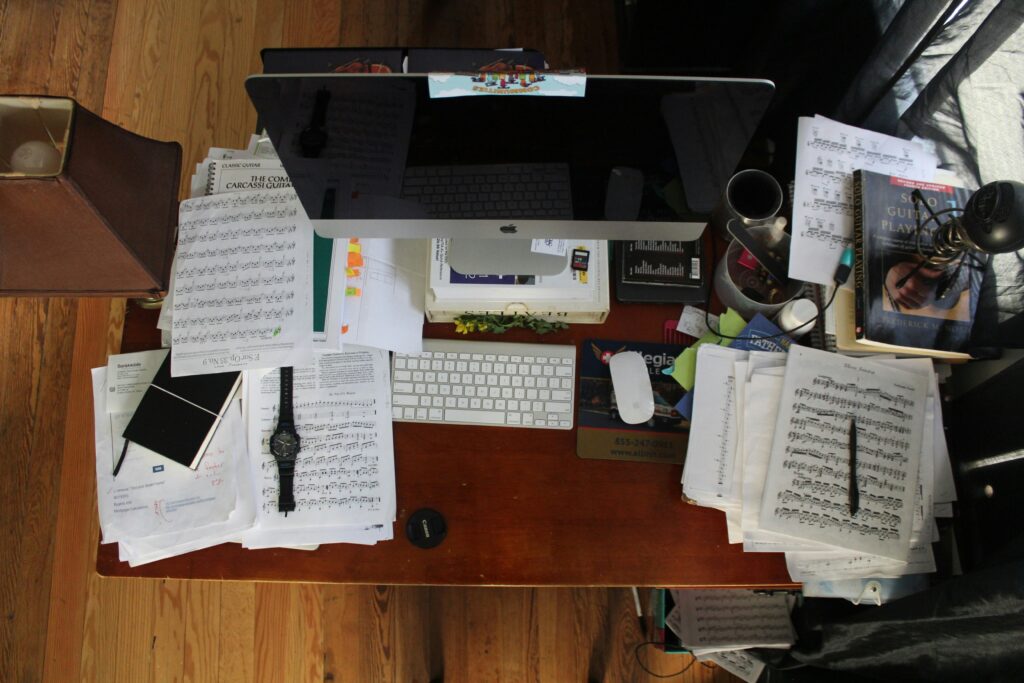
UNDERSTAND (Discover, Interpret, Specify)
What is the challenge
I want to make an educational comic that teaches learners what cognitive overload is and how to spot it in typical learning materials like busy slides, fast videos, and text-heavy pages. I’m focusing on this because I’ve genuinely had moments where I was staring at a “study resource” and felt like my brain just shut down. I used to think that meant I wasn’t smart enough. Now I’m realizing it can be a design problem, not a learner problem.
This comic will teach the idea that good multimedia design reduces unnecessary load, so learners can focus on the actual learning.
Context and audience
Audience: first year university students (or senior high school students) who are learning from digital course materials and are still building study strategies.
Why them: this group is constantly exposed to slides, videos, LMS modules, and “helpful” resources that can sometimes be overwhelming. They also tend to blame themselves when it feels hard.
Learner needs I’m designing for:
- they need information broken into smaller chunks
- they need clear cues about what matters
- they need reassurance that struggle isn’t always about ability
- they need low-barrier, easy-to-follow explanations that don’t add more stress
POV statement
A student who feels overwhelmed by cluttered learning materials needs a simple visual explanation of cognitive load so they can understand what’s happening and use strategies to learn more effectively.
Learning outcomes
After reading the comic, learners should be able to:
- Explain cognitive overload in plain language
- Describe the difference between intrinsic load and extraneous load
- Identify at least three design features that increase overload (ex: clutter, redundancy, no structure)
- Name at least two design strategies that reduce overload (ex: signaling, segmenting, coherence)
- Apply one strategy to improve a slide or study resource they personally use
PLAN (Ideate, Sketch, Elaborate)
Big idea
The comic uses a relatable story: a student is trying to study, gets overwhelmed, and then learns how to “clean up” the learning experience using design principles.
The tone is light and a bit funny, but the learning goal is serious: help learners recognize that learning materials can be redesigned.
Storyboard / Script (14 panels)
Panel 1: Student opens laptop. Screen shows a chaotic slide with tiny text and random images.
Student: “Okay… let’s study.”
Panel 2: Zoom into the slide. It’s packed.
Student: “Why is there… so much happening.”
Panel 3: Student’s brain is shown as a browser with 20 tabs.
Caption: “Working memory = not unlimited.”
Panel 4: A “Guide” character appears (like a friendly sticky note / mascot).
Guide: “Your brain isn’t broken. Your brain is overloaded.”
Panel 5: Guide points to 3 boxes labeled “intrinsic load,” “extraneous load,” “germane load.”
Guide: “Some load is normal. Some load is unnecessary.”
Panel 6: Intrinsic load shown as “new concept” blocks stacking normally.
Caption: “New ideas take effort.”
Panel 7: Extraneous load shown as junk blocks: “decorations,” “extra text,” “random facts,” “too many fonts.”
Student: “WHY IS THIS HERE.”
Panel 8: Student tries to hold everything and drops it.
Caption: “Overload = your brain can’t organize the info.”
Panel 9: Guide: “Let’s fix it.”
Guide removes the junk blocks.
Panel 10: New slide appears with less text and clear headings.
Guide: “This is the coherence principle. Cut what doesn’t help.”
Panel 11: Key phrases are highlighted and arrows point to the most important part.
Guide: “This is signaling. Tell learners where to focus.”
Panel 12: Information appears in chunks: “Step 1, Step 2, Step 3.”
Guide: “This is segmenting. Don’t dump everything at once.”
Panel 13: Student looks relieved.
Student: “Wait… I actually get it now.”
Panel 14: Student rephrases the idea in their own words.
Student: “So it’s not that I can’t learn. I just need better design.”
Caption: “When extraneous load drops, learning becomes possible.”
Design choices and theory connections
- Coherence + signaling + segmenting are used to show how design can reduce overload and guide attention.
- Dialogue is kept short so text doesn’t compete with visuals.
- Each panel focuses on one idea to avoid creating overload inside the comic itself.
PROTOTYPE
For the prototype, I will create a rough 14-panel version using a simple comic template (digital or hand-drawn). The prototype goal is clarity, not perfection.
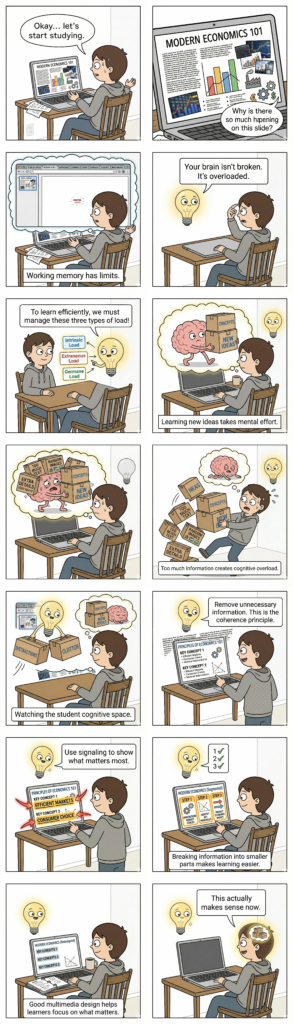
Figure 1. Prototype comic demonstrating cognitive overload and multimedia design principles. Generated using Google Gemini AI and arranged into a comic prototype.
I will share the prototype in the Mattermost channel to get feedback on:
- whether the difference between intrinsic and extraneous load makes sense
- whether the pacing feels too fast or too slow
- whether any panels feel confusing or unnecessary
REFLECT & REFINE (What I expect to revise after peer feedback)
Right now, my biggest risk is trying to explain too much in one comic. If feedback shows confusion, I’ll tighten the script and remove anything that feels like “extra.”
Possible revisions after feedback:
- simplify the wording in the “load types” panel
- add clearer visual labels so learners don’t have to infer meaning
- improve flow between panels with small arrows or “next” cues
- adjust the ending so it includes a concrete takeaway strategy
My goal is that the final comic feels like something a stressed student would actually want to read, not something that feels like a textbook in disguise.
Media I will add to support the final version
You asked for more media without it being bland. Here’s exactly what to add:
Media Elements Supporting the Design
To support the learning goals of the comic, several visual elements will be included in the final post.
A header image showing an overwhelmed student studying at a laptop will be used at the beginning of the post. This image helps establish the relatable problem that many learners experience when faced with complex or cluttered learning materials.
A prototype image of the comic will also be included to demonstrate the visual design process and illustrate the narrative flow from cognitive overload to improved multimedia design. This prototype serves as an example of how the concept is communicated visually.
Finally, a simple, minimalist workspace image may be included near the end of the post to visually reinforce the idea of clarity and reduced cognitive load. This image helps emphasize the coherence principle by contrasting a cluttered design with clean, focused layouts.
References
CAST. (2018). Universal Design for Learning Guidelines version 2.2. http://udlguidelines.cast.org
Mayer, R. E. (2009). Multimedia learning (2nd ed.). Cambridge University Press.
Tribull, C. M. (2017). Sequential science: A guide to communication through comics. Annals of the Entomological Society of America, 110(5), 457–466. https://doi.org/10.1093/aesa/sax046
Morrison, T. G., Bryan, G., & Chilcoat, G. W. (2002). Using student-generated comic books in the classroom. Journal of Adolescent & Adult Literacy, 45(8), 758–767. https://www.jstor.org/stable/40012828